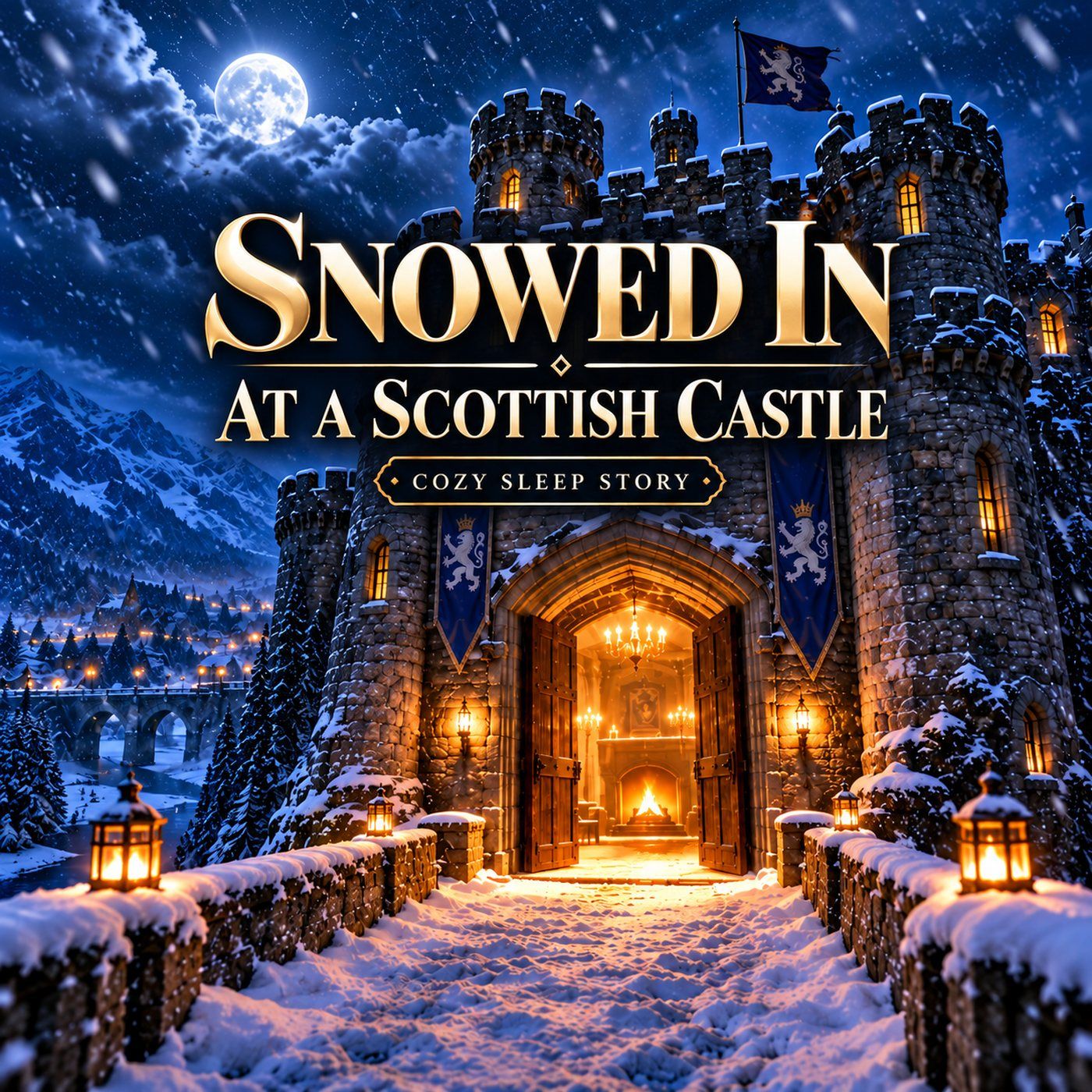
Snowed In At A Scottish Castle
The Story
Snowed In at a Scottish Castle is a cozy winter sleep story filled with falling snow, crackling firelight, gentle wind and peaceful narration.Journey deep into the Scottish Highlands as worsening weather closes the road, leaving you safely tucked inside an old stone castle for one quiet winter night.
Arrive as the first snow begins to settle across the glen, then step inside from the cold and warm yourself beside the fire with tea and shortbread.
Wander through peaceful stone rooms, relax in an old library, enjoy a simple fireside supper and eventually make your way upstairs to a warm four-poster bed.As the castle grows still, the curtains close against the winter night, the fire fades slowly to embers and snow continues falling beyond the window.
There is nowhere left to drive.
Nowhere you need to reach.
Nothing beyond these walls that cannot wait until morning.
This relaxing bedtime story is perfect for anyone who enjoys cozy sleep stories, Scottish Highlands atmosphere, winter ambience, crackling fireplaces and calming stories to fall asleep to.
Tonight, there is nowhere else you need to be — you are simply snowed in at a Scottish castle.🌙
Follow Lantern & Lullaby for more sleep stories, peaceful escapes and relaxing nighttime journeys.
© 2026 Lantern & Lullaby. All rights reserved. Unauthorised reproduction, redistribution or re-uploading is prohibited.
This episode includes AI-generated content.
Welcome to Lantern and Lullaby. Tonight, you're travelling deep into the Scottish Highlands, where snow is beginning to fall across the glen, and an old stone castle waits ahead in the gathering winter dark. Before the evening is over, the road will close beneath the snow, leaving you safely snowed in for the night, with warm fires, quiet rooms, and nowhere else you need to be. So get comfortable, settle in, and let the journey begin. The first flakes appear somewhere beyond the windscreen, only a few at first, small white marks crossing the headlights before disappearing into the darkness beside the road.
The afternoon has been fading for some time, though winter light in the highlands rarely seems to leave all at once. It thins gradually, grey above the hills, blue between the trees. a colder shade settling over the open glen ahead. The road follows the lower slope of the valley, narrow but well kept, with rough stone walls appearing now and then along the verge. Beyond them are pale fields, dark stands of Scots pine and stretches of winter grass flattened by the weather. Another flake crosses the glass, then another.
The forecast mentions snow, Nothing unusual for this time of year, and for now, the road remains clear. Ahead, the glen continues quietly between the mountains. The ridge ahead is still visible, but only just. Its upper slopes have begun to blend with the low cloud gathering around them. Snow moves across the valley in loose curtains, sometimes thinning enough to reveal dark rock and winter heather, sometimes closing again until the mountains seem much farther away. The road rises gently. There is no rush.
The castle is not far now, and you have been told the final stretch is straightforward even in winter. A narrow burn runs beside the road for a while, dark water passing between snow-dusted stones. Further up the slope, patches of old snow remain in sheltered hollows from earlier in the week. The new flakes begin catching there first, white settling over white. The surrounding landscape grows quieter with every mile, not empty, just remote, and increasingly still. At first, it looks like part of the hillside, a broad, dark shape set against the fading sky.
Then the road straightens, and the outline becomes clear. The castle stands on a low rise above the valley, built from dark grey stone and gathered around several different roof lines. One round tower rises above the rest. A few chimneys break the skyline. Snow has already begun collecting along the northern sides of the roofs. It is not enormous, not the sort of fortress built to dominate a landscape. It looks instead like a place that has been added to slowly over generations. Older stone at the centre, later wings extending from it, tall windows where rooms have been adapted for modern use.
The road continues toward it, and the castle remains steadily in view. There are only a handful at first, small rectangles of amber set into dark stone, one near the lower floor, two higher up, another in the round tower, They are ordinary interior lights, but after so much blue-gray winter landscape, they seem particularly warm. The snow falls more steadily now. Individual flakes no longer stand apart. They overlap in the headlights and collect along the dry stone walls beside the road. A line of bare beech trees marks the edge of the castle grounds in the distance.
Their branches hold a thin white covering. The windows ahead remain steady. No flicker. No spectacle. Simply rooms already lit against an early winter evening. The sight changes the feeling of the journey. The road no longer seems to lead deeper into the weather. It leads towards Shelter. The last village was several miles behind. Now there are no houses beside the road, only fields, low walls and occasional trees bent slightly by years of highland weather. The tyres make a soft sound over damp tarmac.
Snow begins settling more readily along the edges, where passing vehicles have not disturbed it. Ahead, a small sign points toward the castle estate. The turning is easy to miss beneath the growing white. You slow, then leave the main road behind. The private drive is narrower, though recently gritted. It climbs gently between two old stone walls. Rhododendron and winter bear shrubs rise behind them. Every branch seems to be collecting its own narrow line of snow. The castle disappears briefly from view, but the warm light you saw from below is somewhere beyond the trees.
The entrance is marked by a pair of square stone gateposts. No grand iron gates are closed across the road. Nothing blocks the way. Only the posts themselves, dark with age and capped now with a fresh layer of snow. A small lamp burns beside one of them. Its light catches the nearest flakes before they fall beyond the wall. You pass between the pillars and enter the grounds. The drive widens. Old trees stand farther apart here. Their trunks rise from lawns already beginning to turn white. A few wheel tracks remain from cars that arrived earlier, pressed darkly through the thin covering.
The castle is still hidden by the slope ahead. For a moment there is only the drive, the trees and the sound of snow touching the windscreen. Then the road begins to curve upward again. The castle appears again across a broad sweep of winter lawn. Closer now. Much closer. The drive follows a slow curve toward it, bordered by clipped hedges and old stone edging. Snow lies lightly across the grass. Where the ground dips, it has already gathered more deeply. A stand of dark evergreen trees protects one side of the property from the prevailing wind.
Beyond them, the mountains are nearly gone from view. Only their lower slopes remain visible beneath the cloud. The castle sits comfortably within the landscape rather than above it. Dark stone. Slate roofs. Tall chimneys. A few carefully placed exterior lamps. Nothing theatrical. Nothing exaggerated. Just a large historic building preparing for another winter night. The tires follow the existing tracks toward the main entrance. The round tower rises from the western side of the castle. Its stonework is darker than the snow gathering along the narrow ledges.
A conical roof sits above it, almost entirely white now. Several windows run vertically up the tower. Two are lit. The others reflect the blue of the winter evening. From this angle, the rest of the castle begins to make more sense. The older central section joins a lower wing. A covered service entrance sits far around one side. The main entrance faces the drive. Everything appears maintained rather than preserved as a museum. Cars are parked discreetly near one wall. A cleared path leads toward a side building.
Small practical details that make it obvious the place is still used every day. The snow thickens as you continue upward. The bridge spans a shallow stone-lined channel running beside the front courtyard. In summer, There may be water below. Tonight, only dark stones and patches of old ice are visible between the falling snow. Low parapet walls run along either side. Their flat tops already hold several centimetres of white. Warm lamps have been mounted at intervals along the approach. They do not brighten the whole bridge.
They create small pools of amber light along the stones. Beyond them stands the main entrance, a broad arch cut into the castle wall, heavy timber doors beneath it. One side is already open. Warm light spills across the inner threshold and reaches a short distance onto the snowy paving beyond. The car slows. You have arrived. The doorway looks almost exactly as it did from farther down the drive. Only warmer. Larger. More ordinary in the best possible way. The open timber door reveals a stone entrance hall beyond.
You can see the edge of a large rug. A console table. The glow of lamps deeper inside. Somewhere further back, firelight moves across the wall. Snow continues falling between you and the entrance. A few flakes land on the stone just inside the arch before melting. The contrast is immediate. Cold blue evening behind you. Dry amber light ahead. There is no ceremony to it. The door is open because guests are arriving and the weather is worsening. And right now, that is all it needs to be. The change in temperature is noticeable at once.
Not dramatic, just enough that the cold loosens its grip on your face and hands. The floor beneath you is made from broad stone flags worn smooth in places by years of use. A heavy mat has been laid near the entrance to catch melting snow. Beyond it, a runner crosses the hall. The air carries the clean smell of wood smoke from somewhere nearby. Not strong. Not smoky. Only the faint scent that belongs to a working fireplace in an old stone building. Behind you, snow continues through the open doorway.
Ahead, the hall extends toward a broad staircase and several quieter rooms. Nothing feels staged. It feels lived in. Warm. Prepared. The fireplace is larger than you expected. It is built directly into the stone wall, with a broad hearth and a simple carved mantle above. Several logs burn behind a low iron guard. The flames are steady rather than high, enough to warm the immediate area without overheating the hall. Two deep chairs sit nearby. A small table rests between them. Someone has placed a folded wool throw over the back of one chair.
The rest of the entrance hall remains practical. An umbrella stand near the door. A narrow bench. A place for wet coats. A rack where outdoor boots can be left rather than carried through the carpeted rooms. It is exactly the sort of arrangement a building like this needs in winter. The cold has followed you inside in small ways. Snow caught around the edges of your boots. A few damp marks along the hem of your coat. Fine droplets left across the shoulders where flakes have melted. There is somewhere sensible for everything.
Boots are left near the entrance. Outer layers can dry where the stone floor will not mind a little water. The warmth from the hearth reaches farther than it seemed to from the doorway. After several minutes on the winter road, even the simplest things feel noticeable. Dry socks. Warm air. The absence of wind. Behind you, the main door remains partly open while the last arrivals are dealt with outside. But here, beside the fire, the journey already feels finished.
You sit down without hurry. The chair is deeper than it first appeared. Its fabric is heavy, slightly textured, made for regular use rather than display. From here, the fire is close enough to warm your hands. You hold them toward it for a moment. The sensation returns gradually to your fingers. Across the hall, the staircase rises to a half-landing before turning toward the upper floor. A tall window beside it shows only fragments of the courtyard through the snow. The castle is quiet, though not silent.
A door closes somewhere farther along the corridor. Floorboards answer faintly above. The fire shifts. Ordinary sounds inside an old building settling into evenings.
The teapot is still hot. Steam gathers briefly around the lid when you pour. Beside it are two pieces of shortbread on a plain white plate. Nothing elaborate. Exactly right after the drive. The first sip is almost too warm. You wait. Try again. This time it is comfortable. The tea carries its own small heat through your hands as much as through the cup Outside, winter continues without needing your attention. You can hear the weather occasionally against the entrance door. A soft rush of wind, the faint hiss of snow moving across stone.
But those sounds seem removed now, buffered by walls several feet thick and the steady crackle from the hearth. The snow itself makes almost no sound. It is the wind that gives it movement. Every so often, a gust sweeps across the front of the castle and sends loose flakes against the high windows. The glass answers with the faintest dry brushing noise. Then everything settles again. Inside, the hall remains unchanged. The fire burns evenly. The lamps hold their soft amber light. The tea stays warm in your cup.
There is something reassuring about hearing the weather from this side of the wall. You know exactly what is happening outside. Snow is falling harder. The temperature is dropping. The road may become slower later. But none of that requires anything from you now. You are already where you intended to be. There is no need to carry anything further tonight. Your bag has already been taken upstairs to the room. It is a small detail, but a welcome one. The practical part of arriving is over. Nothing needs unloading.
Nothing needs organising beside the door. The room key rests nearby, attached to a simple wooden fob. No ornate brass tag. No unnecessary ceremony. Just the number of the room marked discreetly on one side. You leave it where it is for now. There will be plenty of time to go upstairs later. For the moment, the fire is too comfortable, and the chair has begun to feel like exactly where you were meant to stop after the journey. Eventually, you stand and cross the hall. The tall window beside the staircase looks over part of the inner courtyard.
Earlier, from outside, the ground was only lightly covered. Now the stone paving has almost disappeared. Only the darker edges nearest the walls remain visible. A few courtyard lamps burn below. Their light catches the falling snow in narrow cones. The flakes look heavier here than they did on the road. Not larger, simply more numerous. One of the lower roofs has already taken on a smooth white covering. Beyond it, the round tower rises into the darkening sky. The castle looks different from inside.
Less imposing, more practical. A group of warm rooms gathered around a sheltered courtyard while winter settles beyond them.
The open entrance is no longer needed in quite the same way. The final movement around the doorway begins to slow. The mat near the threshold has been dampened by arriving boots. Snow has collected in a thin line just beyond the outer step. The wind reaches through whenever the door opens fully, cooling the nearest part of the hall for a few seconds. Then warmth returns. Outdoor lamps remain on. The bridge is still visible beyond the arch. but the tracks across it are already softening at the edges beneath fresh snow.
The castle is not shutting the world out. It is simply changing from afternoon arrival to winter evening. Doors secured. Fires tended. Lights left on where they are needed. Everything ordinary. Everything prepared.
The door moves slowly on heavy hinges. For a moment, the snowy bridge remains framed in the narrowing gap. Blue evening. Amber lamps. White flakes crossing the light. Then the outside view disappears. The latch settles into place. Not with a dramatic echo. Only a deep, solid sound of timber meeting stone. The effect is immediate. The wind becomes distant. The hall feels warmer. Smaller somehow, despite its high ceiling. More contained. The fire continues burning beside the chairs. Your empty teacup remains on the table.
Above, somewhere beyond the staircase, your room is waiting. Outside, the snow can continue for as long as it likes. There is nowhere you need to go tonight. And for the first time since leaving the main road, you realise how good that feels. The drawing room sits just beyond the entrance hall. A quieter room. Lower ceiling. Softer light. The stone walls remain visible in places, though dark wood panelling covers the lower half of the room. A broad window looks toward the western side of the grounds.
Two deep sofas face a modest fireplace. Several armchairs sit nearby. Nothing matches perfectly. Nothing needs to. The furniture looks chosen over time rather than bought as a set. The fire here is smaller than the one in the hall, more suited to sitting close beside. You carry the last of your tea with you. Outside the window, snow continues passing across the darkening lawn. Inside, the room feels immediately less formal.
The chair gives more than expected when you sit. Its cushions have softened with use. The arms are broad, the back high enough to support your shoulders without forcing you upright. You place the cup on a small table beside you. The fire is close enough to feel across your knees. Not hot, just steady. The room is warmer than the hall. Or perhaps it only feels that way because there is less space around you. The wind continues beyond the outer wall. You hear it faintly now. A low passing sound rather than a gust.
The sort of noise that makes being indoors feel more complete. From this chair, the fire and the window share the same view. Warmth on one side, winter on the other. The flames move behind a simple black grate. Outside, the last of the daylight sits low over the grounds. Snow gathers along the lower stone edge of the window. The glass is clear enough to see the lawn, but the far trees are already becoming less distinct. A narrow path cuts across the grass toward the side of the castle. Its edges are softening under fresh snow.
Nothing outside looks dangerous, only colder, quieter, further away than it did an hour ago. The road lies farther away than it's seen during the drive. From here, it appears only in sections. A dark curve between pale fields. Then nothing. Then another short stretch beyond a stand of trees. The snowfall makes distance difficult to judge. One moment, the road is visible. The next, it seems to vanish completely. A pair of headlights move slowly along the lower valley, then disappears behind the slope.
For a while, there is no movement anywhere. Only snow, field, trees, and the faintest remaining line of the road. The update is simple. The lower road has been closed for the night. Not because of any accident. Not because anything has gone wrong. The snowfall has simply become heavy enough that the safest decision is to wait until morning. The gritters will pass through later. The road will be checked again after first light. Until then, nobody is expected to leave. The information changes very little.
You already plan to stay. Your room is ready. The castle is warm. The evening is here. is only beginning. If anything, the closure removes the last small possibility that you might need to think about the road again tonight.
The castle has seen evenings like this before. Many of them. There is nothing improvised about the way it responds. Firewood is stacked beneath cover. Salt and grit have already been spread near the entrances. The kitchen is stopped. The heating is on. There are torches in the cupboards if the power ever fails, though nobody expects it to. The staff who live nearby have already arranged to stay. Everything that matters has been considered long before the first flake fell. That knowledge settles into the room.
The weather can worsen. The castle does not need to. The idea of leaving disappears completely. Not dramatically. It simply stops being part of the evening. There will be no checking the road. No wondering whether the weather might ease enough to drive back out. No decision waiting later. You are staying. The room key remains with you. Your bag is upstairs. Supper will be served here in the castle. Morning can deal with the road. That certainty is unexpectedly relaxing. A choice has been removed.
And what remains is simple. A warm room. A fire. A winter night with nowhere else to be. A fresh log has been added to the fire. It takes slowly, first darkening at the edges, then catching along one split in the wood. A narrow flame appears, then another. The room brightens almost imperceptibly. No sudden flare, no rush of heat, just a little more warmth, a little more light, the sort of adjustment made without anyone drawing attention to it. Outside, snow continues settling over the grounds. Inside, the fire is simply kept where it needs to be.
The library lies directly beyond the drawing room. Its door has been left open. From where you sit, you can see part of the room. Dark shelves. A reading lamp. The edge of another fireplace. A tall chair facing away from the doorway. It looks quieter still. Not larger. Not grander. Just more enclosed. You finish what remains of the tea. Set the cup down. And after a few minutes, move through. Two leather chairs sit nearest the fire. Not new. Their arms are slightly polished from years of use. One has a small cushion at the lower back.
The other sits beside a narrow table with a reading lamp. Books fill the walls from waist height almost to the ceiling. A rolling ladder rests unused against one section. There is no sense of display. The shelves look red. Some books stand perfectly upright. Others lean. A few gaps remain where volumes have been taken elsewhere. The room feels used in exactly the right way. You choose without thinking too hard about it. Something familiar in size. Not too heavy. Not the kind of book that asks for concentration.
The cover is plain. The page is slightly yellowed. It opens easily near the middle. You take it back to the chair nearest the fire. There is no intention of reading for hours. Only something to occupy the hands while the weather carries on outside. The room does the rest.
The window is set deep into the stone, deep enough for a built-in seat. A cushion runs along the ledge. Another has been placed against the wall. From here, the glass feels almost separate from the room, a thin boundary between warmth and winter. The courtyard lies below. Its paving is becoming harder to distinguish beneath the snow. The lamps are brighter now that the sky has darkened. Each one creates its own small circle on the ground. Beyond them, the opposite wall of the castle rises into the evening.
The lamps below do not reach far. That makes them more noticeable. Small pools of warm light. Then darkness. Then another. Snow passes through each one in turn. Visible for a second. Gone again. The centre of the courtyard is almost completely white now. Only a few darker lines remain where the stone meets the walls. No footprints cross the open space. No one has reason to be out there. The whole courtyard seems to have settled into the same decision as the castle. Stay inside. Wait until morning.
The round tower stands beyond the lower roof. You recognize it from the drive. From outside, it seemed taller, more separate from the rest of the building. From here, it looks connected, part of the same collection of rooms, stairs and roofs. Two windows are lit. The others remain dark. Snow has gathered around the lower edge of the conical roof, a thin white line against dark slate. For a few seconds, The snowfall eases enough to see the stone clearly, then thickens again.
The lower roofs have changed almost completely. Slate that was dark when you arrived is now interrupted by long white bands. Snow gathers first where roof angles meet. Along gutters, behind chimneys, at the base of small dormer windows. The accumulation looks uneven because it is. Wind clears one section and fills another. A narrow plume of smoke rises from a chimney and disappears into the falling snow. The building is warm beneath all of it. That much is obvious from here. The clock is small enough that you barely noticed it earlier.
It stands on a shelf near the fireplace. Dark wood. Simple face. A soft tick that only becomes audible once you listen for it. The hands have moved further into the evening. Not late. Just later. There is still plenty of time before supper. The fire continues steadily. The room has changed less than the weather outside. That contrast makes the passing hour feel almost irrelevant. The fresh pot is smaller than the first one. Enough for another cup. Nothing more. Steam rises briefly when the lid is lifted.
The tea is darker now. Stronger. You pour only a little. The book remains open nearby, untouched for several minutes. The chair has become more comfortable. The room quieter. Outside, the snow keeps falling with no sign of hurry. Inside, there is even less. The walls are deeper than they appear from inside the room. You notice it most around the windows. Stone extending inward. Glass set far from the outer face. The result is a kind of quiet that modern buildings rarely have. The wind still exists.
The snow still crosses the courtyard. But almost none of it reaches you as sound. Only the occasional low note against the upper parts of the building. Everything else is absorbed. Stone. Timber. Curtains. Carpet. Fire. The castle does not silence the weather. It simply keeps it at the right distance. The change happens gradually. The courtyard loses its last blue-grey colour. The sky darkens. The snow becomes brighter wherever the lamps catch it, dark everywhere else. Windows across the courtyard stand out more clearly now, small warm rectangles in the stone.
The round tower is still visible, but only because its edges hold snow. The rest of the landscape has gone. The mountains, the lower road, the open glen, all of it has disappeared into night and weather. The castle is the whole world for now. There is a point when being snowed in stops sounding unusual. It simply becomes the shape of the evening. The road is closed. The mountains are hidden. Snow covers the courtyard. And yet nothing feels confined. Quite the opposite. The castle feels larger now that there is nowhere beyond it you need to consider.
There are rooms downstairs. A library. Supper later. Your bedroom upstairs. A warm bed waiting at the end of all of it. The fire shifts quietly. You close the book. Set it aside. And for the first time, the idea of spending the entire night here feels less like a change of plan, and more like exactly what you came for. The dining room is smaller than you expected. Not the formal hall you might imagine in a castle. No long tables stretching beneath portraits. No rows of empty chairs. Instead, this room feels almost domestic.
A modest table has been set near the fireplace. The stone walls are partly covered with dark wood panelling. A broad window looks toward the courtyard. The fire is already burning, warm enough to soften the chill that always seems to linger in old stone after dark. A shaded lamp stands against one wall. Another pools light across the table. Outside, snow crosses the window steadily. Inside, the room is simple, quiet, and ready. The chair is close enough to feel the fire, not close enough to become uncomfortable.
The table has been laid simply. White plate. Folded napkin. Clear water glass. A knife and spoon. Nothing ornate. Nothing that makes the meal feel like an event you need to perform properly. From here, the window sits beyond the far edge of the table. Snow passes steadily across it. The courtyard lamps are still visible, but less clearly than they were from the library. The storm has not become dramatic, only thicker, more settled. You pull the chair closer, and the room seems to narrow comfortably around the fire and the tables.
The soup is exactly what the weather calls for. Thick, warm, simple. Its surface moves slightly when the bowl is set down. Steam rises in a thin line. The smell is earthy. Root vegetables, herbs, something rich beneath them. A small piece of bread rests beside the bowl. No elaborate garnish. No attempt to turn comfort into decoration. You take the first spoonful slowly. Heat follows almost immediately. Not just from the food. From the fire at your side. From the room itself. The whole castle seems to be doing the same thing now.
Keeping winter exactly where it belongs. Outside. For a while, the smallest details hold your attention. Steam gathering above the soup. The shine of firelight along the spoon. A faint reflection in the water glass. The quiet sound of the fire settling behind the grate. Outside, a gust presses snow briefly against the window, then passes. The glass clears again. Beyond it, the courtyard has become mostly white. The nearest lamp still burns steadily. The rest seem farther away now. You take another spoonful, then another.
There is no reason to hurry. Nothing is waiting beyond the meals. The bread is still slightly warm in the middle. A small dish of salted butter sits beside it. You break off a piece. The crust gives easily. The inside is soft. Nothing about it is unusual. That is part of why it feels so good. Outside, the snow continues falling across stone that has been here for centuries. Inside, supper is bread. Butter. Soup. Fire. A warm chair. Ordinary comforts made better by the weather beyond the glass. By the time the soup is almost finished, the room feels less like somewhere you have been seated for dinner, and more like somewhere you have simply settled.
The snowfall looks heavier from this room, perhaps because the window faces the courtyard directly, perhaps because the sky has darkened further. The flakes move across the glass in greater numbers now. Some catch briefly against the outer ledge. Others are lifted again by the wind. The courtyard lamps still mark the edges of the space, but the paving between them has almost vanished. Only a darker strip close to the wall remains. Nothing outside moves. No footsteps. No vehicles. Just weather settling over stone.
The fire remains steady beside you. The contrast is complete. The main course is simple. A slow-cooked piece of beef with potatoes and winter vegetables. Nothing arranged too carefully. Nothing too large. Just enough. Gravy gathers at one side of the plate. The vegetables still hold their colour. The potatoes are soft enough to break with the side of the fork. It is the sort of food that belongs to cold weather. Food meant to warm rather than impress. Outside, the wind passes across the courtyard again.
Inside, the first bite is rich and uncomplicated. The meal continues at the same pace as the evening, slowly, without asking anything from you. The fire reaches the table only in small ways. A warm edge along the glass. A shifting reflection in the spoon. A softer colour across the wood. The room does not glow. It simply feels warmer than the night outside. The flames rise slightly when one log settles. Then return to their steady height. Nothing else changes. The meal remains warm. The lamps remain still.
The snow keeps falling. For several minutes, the entire evening seems reduced to those three things. Food. Fire. Weather. And nothing more is needed.
The far side of the courtyard is harder to see now. The walls remain. The lamps remain. But the edges between things have softened. Snow gathers on window ledges. On the tops of low walls. On the stone steps beyond the opposite door. The round tower is no longer visible from this angle. Only the lower buildings surrounding the courtyard. Their windows shine through the weather, warm, ordinary, occupied. The castle does not look grand from here. It looks sheltered. That feels better. Nothing about the room suggests this weather is unusual.
The firewood basket is full. Heavy curtains wait beside the window. The door fits closely into its frame. A small draught excluder rests along the threshold. Even the furniture seems arranged with winter in mind. Chairs close enough to the fire. Tables within reach. Lighting kept low and warm. This room has probably looked much the same during hundreds of cold evenings. Snow outside, supper inside, the same simple separation between the two. There is comfort in knowing the building has done this before, long before tonight, and will do it again.
Dessert arrives without ceremony. A small warm pudding. Nothing elaborate. Just enough sweetness to finish the meal. A little cream pools around the edge. Steam is barely visible now that the room is so warm. The fire has burned lower during supper. Still steady. Still comfortable. Outside, the snowfall continues. The window is darker than before. Only the nearest courtyard lamp remains clear. You take your time with the last few spoonfuls. There is no reason to make the evening move faster. You stay in the dining room after the plates are gone.
A small cup sits on the table. Coffee this time. Hot enough that you leave it untouched for a minute. The chair has been turned slightly toward the fire. The rest of the table is almost empty now. Only the cup. The water glass. A folded napkin. The room feels quieter without the meal in front of you. Outside, snow moves beyond the glass. Inside, The fire makes occasional soft sounds as the logs settle. You could leave. There is no reason to. So you stay for another few minutes. The sound reaches the dining room faintly.
A clock somewhere in the entrance hall marking the hour. Not loud. Not enough to interrupt anything. Just several soft notes travelling through stone corridors. You listen until they stop. The silence that follows feels deeper. Later than before. Though still not truly late. The coffee has cooled enough to drink. Outside, the snow continues. Inside, the castle has shifted into the quieter part of the evenings. Doors open less often. Footsteps are fewer. The fires do most of the talking now. The entrance hall feels different now.
Not changed. Only quieter. The large fire still burns. The staircase remains softly lit The tall window beside it has darkened completely. Snow presses against the outer edges of the glass. The rugs look richer in the lower evening light. The chairs beside the hearth are empty. Your tea things have been cleared away. Nothing remains from the arrival except the faint dampness near the entrance mat. The journey here feels much longer ago than it really was. The front doors look heavier at night. Dark oak.
Iron fittings. Stone arch around them. Nothing about them has changed since they were closed earlier. But knowing what lies beyond makes them feel more substantial. Snow. Wind. A bridge already whitening when you came inside. The road somewhere beyond the grounds. All of it held on the other side of several inches of timber and stone. A thin line of cold shows beneath the threshold. Not enough to matter. Only enough to remind you that winter is still there. A narrow side window gives one last view of the approach.
The bridge is still there, but most of its stone has disappeared beneath white. The low parapet walls carry thick, rounded caps of snow. The lamps continue burning, each one lighting a small patch of the bridge before the darkness takes over again. The tracks from earlier have almost gone. Only shallow depressions remain, The storm has not covered everything yet, but it is getting close. From here, the bridge looks less like a route out, and more like part of the castle itself, something waiting quietly until morning.
The gust is stronger than the ones earlier. You hear it move around the front of the building. Across the bridge. Against the stone. Past the high windows. The castle answers only in small ways. A faint movement at the door seal. A low sound somewhere high in the roof. Then quiet again. Nothing rattles. Nothing shifts. The building feels solid around you, not because it is dramatic, because it is old, heavy, built from materials that do not need to prove themselves. The fire remains steady behind you.
There is nothing practical left to think about tonight. The road has been dealt with. Your room is ready. Supper is finished. The doors are closed. The weather is outside. Morning will bring whatever it brings. For now, every small decision has already been made. Even the room key in your pocket no longer feels like something you need to remember. The evening has narrowed comfortably. Library. Fire. Bed later. That is enough. You notice the warmth of the meal as you move away from the hall. Not heat, exactly.
More a comfortable heaviness. The kind that makes every room seem softer. The library lies ahead. Its lamps are still on. The fire has been tended. The chair you left earlier waits in almost the same position. The castle has not moved on without you. It has simply become quieter. For a while there will be nothing to do except sit. Perhaps read another page. Perhaps not. You pause at the library door. Behind you, the entrance hall has gone quiet. Ahead, the fire burns in the room you already know.
Outside, Snow continues covering the courtyard and roofs. There is still plenty of night left. Time before bed. Time for another quiet drink. Time to watch the weather from the window if you want to. Nothing is scheduled. Nothing is expected. The storm has removed the last reason to measure the evening in hours. For now, the night is simply here. Warm inside. snowing outside, and entirely yours. The library feels even quieter when you return. Nothing has changed. The chairs remain beside the fire.
The books stay exactly where they were. The lamp nearest the window still casts the same small pool of light across the floor. But the room feels later now. Perhaps because the meal is behind you. Perhaps because the rest of the castle has gone still. The fire burns lower than before. Outside the deep window recess, snow continues falling into the courtyard. The nearest lamp below is still visible. Most of the others have softened into the weather. You cross the room without hurry. The leather chair near the fire is waiting.
The blanket is heavier than it looks. Plain wool, softened by use. You settle it across your knees before sitting back. The chair seems deeper now, the fire warmer even though it has burned lower. A small shift in the logs sends one brighter flame along the edge of the grate. Then it settles again. The blanket holds the warmth close. Outside, wind pushes snow across the courtyard in a low sweep. Inside, nothing moves except the fire. the room has reached that point in the evening when comfort no longer needs improving it only needs to continue you open the book again not from any real determination to continue only because it is there a few pages pass slowly The words hold your attention for a while, then less, then hardly at all.
The room keeps drawing it away, a small sound from the fire, snow beyond the window, the soft pool of light from the lamp. You find yourself reading the same line twice, then smiling at the fact that it does not matter. The book is not here to be finished. It is simply part of the evening. The fire no longer fills the grate. It has drawn inward. Fewer flames now. More red beneath the logs. Occasionally, One small tongue of fire appears where the wood has split, then fades. The room does not feel colder.
If anything, it feels calmer. The earlier brightness has softened into something steadier. The lamp does most of the work now. The fire only adds movement. A slow pulse of orange against stone. The kind of light that makes getting up seem unnecessary. For a few more minutes, you stay exactly where you are. The painting above the fireplace is easy to overlook. A winter landscape. Not this castle. Not this glen. Some other stretch of Scottish country. Low hills. Dark trees. Water beneath a grey sky.
The colours are muted enough that the picture almost blends into the wall. In brighter daylight, it might seem plain. At this hour, it suits the room. Quiet weather painted inside. Quiet weather continuing outside. No grand story attached to it. Only another reminder that winter has always belonged naturally in places like this. The shelves nearest the hearth catch the last of the stronger firelight. Dark wood becomes warmer. Brass fittings catch narrow lines of orange. The books seem darker now than they did earlier.
Some almost disappear into shadow. Others catch just enough light to show worn cloth and leather along their spines. Nothing on the shelves asks for attention. There are no rare treasures arranged for display, no locked cabinets, no sense that the room is guarding anything. They are simply books, used, kept, left where people can reach them. That ordinary quality makes the room easier to trust. the courtyard has changed again not dramatically only enough that the paving is gone completely now a smooth white surface lies between the buildings the low walls carry thicker rounded caps of snow the nearest lamp creates one clear circle below beyond it The rest of the courtyard fades gradually into darkness.
Snow continues falling through the light. No footprints disturb the centre. The castle seems to have stopped using the courtyard for the night. It belongs entirely to the Westworlders. now. You watch for a while. There is something satisfying about seeing snow fall where nobody needs to cross it. The round tower is harder to see now. Its stone has almost disappeared into the night. Only the roofline remains clear where snow outlines the dark slate. Two windows still glow, exactly where they were earlier.
Small, warm rectangles set into the stone. They make the tower seem less like a landmark and more like part of the castle. Rooms somewhere beyond those windows. Heat. Lamps. People already settled for the night, though none are visible. The snowfall passes between you and the tower. For a few seconds, it thickens enough to hide one window. Then both return. The sound comes from somewhere above. A small movement in old timber. Then another, farther away. Nothing sharp. Nothing unexpected. The kind of sound a large building makes when the temperature outside falls and the warmth inside holds steady.
A pipe gives the faintest tick within the wall. The floorboards answer once near the doorway. Then everything becomes still again. There is no mystery in it. The castle is simply cooling at its outer edges. Timber. Stone. Metal. All adjusting by fractions. You listen for another sound. None comes. The final drink is simpler than the others. Warm milk with a little honey. Nothing strong. Nothing meant to keep the evening going. The cup is small. Steam rises briefly and disappears. You leave it on the table until it cools enough to drink.
The book remains closed beside it. Outside, snow continues. Inside, the fire is almost all embers now. The drink feels less like another part of the evening and more like the beginning of bedtime. A quiet line between staying downstairs and finally going up. You place the empty cup beside the book. The cover remains shut. There is no reason to reopen it now The library has done enough. The chair has done enough. The fire has carried the evening as far as it needs to. You sit for another minute anyway, not reading, not thinking about anything in particular, simply letting the room become quieter around you.
Eventually, you stand. The blanket is folded back over the arm of the chair. The book remains on the table, Everything looks ready to be found again in the morning. The entrance hall is quieter than before. The fire still gives enough light to recognize everything. The chairs. The rug. The closed doors. But your attention moves upward now. The main staircase rises from the far side of the hall, dark oak beneath a long runner. The steps are broad, worn slightly at the center. At the half landing, the tall window shows nothing but night and snow.
The handrail catches a soft line of lamplight. There is no rush to climb. You simply begin. One step, then another. The upper corridor is warmer than the staircase. Not by much, just enough to notice. Lamps are fixed at intervals along the wall. Each one creates its own pool of soft light. Between them, the corridor is dimmer. The runner continues beneath your feet. Dark red. Muted by years of use. Heavy oak doors line one side. Tall windows, the other. No one is moving through the corridor now.
The castle seems to have drawn everyone into their rooms. Only the lamps remain. Steady. Practical. Enough to show the way.
The windows sit deep within the outer wall. Each one offers a slightly different view. One looks across a lower roof, another toward the courtyard. A third catches part of the round tower. Snow has collected along the outside ledges. The glass is colder here than downstairs, but the corridor remains warm. You pause at one window. The roof below is almost completely white. Only a few dark sections of slate remain exposed where the wind has cleared them. Beyond it, snow continues through the night.
The walls between the windows hold a collection of old frames. Not portraits. Landscapes. Maps. A botanical study faded almost to brown. One drawing of the castle from years ago. They are hung without perfect symmetry. Some higher than others. One frame slightly darker with age. Nothing feels curated for display. They look as though they have simply remained here because nobody has found a reason to move them. The corridor feels lived with. Not preserved. That difference matters. The runner grows quieter beneath your steps.
Thicker here. Dark red with a faded pattern. It follows the corridor all the way toward the far end. Stone still shows at either side. The lamps become fewer, the rooms more widely spaced. A small table stands beneath one window with nothing more than a ceramic bowl on it. The corridor feels private now, separated from the larger rooms below. No sound reaches this far except the occasional wind beyond the glass, and even that seems softer. Your door is near the end. Dark oak. Simple iron handle.
No decoration beyond the grain of the wood. You recognize it from the key. There is no brass plaque. No elaborate sign. Nothing announcing the room. You stop for a moment before opening it. The corridor behind you remains warm and quiet. A lamp burns nearby. Snow moves beyond the nearest window. Then the key turns easily, the latch releases, and the room beyond is already warm. The bedroom fire has been lit before you arrive. It is smaller than the fires downstairs, exactly right for the room. Two logs burn steadily behind a simple grate.
The stone surround is plain. A basket of extra wood sits nearby. Nothing about it feels decorative. It is there because the night is cold, and because rooms like this need warmth. from more than one source. The fire changes the whole atmosphere. The bedroom does not feel like somewhere you have just entered. It feels prepared,
The curtains have already been drawn partway across the window. Not fully. Enough to keep the room warm. Enough to leave part of the night visible. Beyond the glass, snow falls across the courtyard. The round tower appears through the opening between the curtains. Only partly. One section of stone. The lower edge of its roof. A warm window beyond the snow. Inside, the curtains are heavy and lined, dark fabric with a faint woven pattern. Practical first, beautiful only because they suit the room.
The whole room seems arranged around the season. The bed sits beneath a dark, carved frame. Cream linen already turned down. A deep red tartan throw folded across the foot. The small fireplace burns nearby. Heavy curtains hold most of the cold against the glass. A wool rug softens the floor beside the bed. Water waits on a small table. A shaded lamp gives just enough light. Nothing is luxurious for the sake of being seen. Every comfort has a purpose. Warmth. Quiet. Rest. After the drive, the snow, the road closure and the long evening downstairs, the room feels like the natural end of the day.
The bed is the first thing that feels different now that you are standing beside it. From across the room, it seemed substantial. Old-fashioned. A little formal. Up close, none of that matters. The dark oak frame surrounds something remarkably simple. Cream linen. Two deep pillows. A lighter blanket beneath the folded tartan at the foot. The covers have already been turned back. Not dramatically. Only enough to make the invitation obvious. You run your attention across the room once more. The fire.
The curtains. The lamp. The water waiting nearby. Everything necessary for the night is already here. Nothing else is required.
The carafe is cool when you lift it. Clear glass. Plain. A small tumbler beside it. You pour only a little. Enough for later. The room is so quiet that the sound of water seems briefly louder than it should. Then the glass is set down again. Nothing follows. The fire gives a small crack from across the room. Snow brushes faintly against the window. The carafe remains within easy reach of the bed. One small practical detail among many. The sort you barely notice when it is there and would immediately miss if it were not.
You sit for a little while longer The chair beside the fireplace is firmer than the one downstairs. Smaller too. Made for a bedroom rather than an evening spent reading. From here, the fire is close enough to feel directly. Not hot. Only comfortably present. Two logs have settled lower against one another. Orange light moves across the stone surround. Across the room, The bed waits beneath its dark frame. There is no book beside this chair. No reason to begin anything else. The day is finished. You are simply allowing yourself to notice it.
The fire changes almost without notice. The taller flames disappear first. What remains stays lower around the wood, steadier, red beginning to show beneath. There is enough heat in the stone now that nothing needs adding. The basket beside the hearth remains untouched. You could put another log on. There is no reason to. The room is warm. The bed is ready. By morning, the fire will have gone out on its own. That seems exactly as it should be. The window has become almost entirely a winter picture.
Snow moves continuously across the glass. Nearer flakes appear white for a moment as they catch the room's light Beyond them, the courtyard is darker. The tower is still there, part of its stone visible between the curtains. One warm window remains in view. The roof below has lost nearly every trace of slate. You stand without touching the curtains. There is no need to check the road. No reason to wonder whether conditions have improved. You already know they have not, For tonight, that question has been answered.
You draw the curtains a little farther together. Not completely. A narrow opening remains between them. Enough for one strip of winter night. Enough to see snow passing whenever you look. The heavy fabric meets with a soft weight. Immediately, the room feels smaller, warmer somehow. The window is still there. The courtyard's still beyond it. But most of the cold blue light has disappeared. What remains belongs to the lamp and the fire. A bedroom now, rather than a room with a view. The lamp across the room goes dark.
The change is gentle. One corner simply retreats into shadow. The bedside lamp remains. So does the fire. Together they are enough. The carved bedposts hold narrow bands of warm light. The wardrobe almost disappears against the wall. The tartan at the foot of the bed deepens from red to something closer to burgundy. Nothing has vanished. The room has only stopped asking to be looked at. It is becoming a place for sleep. The linen is cool at first, only at the surface. Beneath it, the bed holds the warmth of the room.
You pull the covers farther back. The mattress gives gently beneath the weight. The tartan throw remains folded across the lower end. Useful if the temperature falls before morning. For now, it can stay where it is. The pillows are deep without being overfilled. The sheets plain. Nothing scented. Nothing elaborate. Just clean linen in a warm room while snow continues beyond thick stone walls. The bed feels deeper once you are beneath the covers, not soft enough to disappear into, just enough to let your weight settle.
The linen warms quickly. From here, the room looks different again, lower, quieter. The nearest carved bedpost rises at the edge of your view. Beyond it, the fireplace sits across the room. The flames are smaller now. The lamp beside you casts light only as far as it needs to. And through the narrow space between the curtains, snow is still falling. The final lamp has been the brightest thing in the room. When it goes out, darkness does not arrive all at once. The fire remains. small orange glow across the floor the curtain gap remains too a narrow line of blue gray night your eyes take a moment to adjust then the room returns in simpler shapes bedpost fireplace curtain window nothing else needs to be clear You lie back, the pillow settles beneath you, and the bedroom becomes properly dark.
From the pillow, only a narrow piece of the window is visible, a vertical strip between the curtains. Snow crosses it endlessly, sometimes quickly. Sometimes almost straight down. Then the wind catches it again. There is no longer enough of the view to see the courtyard properly. Only darkness. Snow. And once in a while, the faintest suggestion of warm light beyond. You stop trying to identify where it comes from. It does not matter. Outside can remain outside now. The wind is different from up here.
Not louder. More distant. It moves somewhere beyond the thick wall. Around the tower. Across the roof. Past the window in a low, continuous breath. Nothing rattles. The curtains hardly move. The room is too well sheltered for that. You hear the weather rather than feel it. stone between you and the cold, glass, lined curtains, fire, blankets, layer after layer separating this room from the night. One of the logs gives way quietly. Not with a crack, more a soft collapse into the grate. A few sparks rise, gone almost immediately.
After that, the fire is lower still. Very little flame remains. Mostly red now, a deeper orange where the wood has split. The stone around the hearth keeps its warmth. There is no reason to get up, no reason to add anything. The fire is doing exactly what fires do at the end of a long night, burning itself gently toward darkness. The snowfall has a silence of its own. It fills the courtyard, covers the roofs, builds against ledges and low walls. And with every new layer, the outside world seems farther away.
Even the wind has softened again. You can no longer hear anything from the corridor. No doors. No footsteps. No distant voices. The castle has settled completely. Whether anyone else is awake no longer matters. From this room, there is only the small fire. and snow beyond the curtains. There is a particular comfort in knowing you cannot go anywhere tonight, not because anything is wrong, simply because the decision has already been made by the weather. The road is closed. The car can remain where it is, Whatever plans existed beyond the glen can wait until morning.
There is nothing to check, nothing to prepare, no departure time to think about. You are warm. You have a room. The castle is quiet. Outside, the snow can continue for as long as it likes. There is no way to tell what time it is. You have not looked. The room gives no clue. The fire has almost gone. The narrow window gap is dark. Snow still passes through it whenever your eyes open, then disappears again when they close. Thoughts have begun losing their edges. One arrives, does not finish. Another takes its place.
Then that fades too. The pillow is warm now. The blankets heavier than they seemed before. Deep night has reached the castle and you have nowhere else to be. One ember near the centre of the grate holds its colour. A small deep red point among darker ash You watch it without meaning to. It brightens when a little air reaches it, then settles. Nothing dramatic. Nah, final flare. Just heat leaving the wood slowly. The rest of the hearth is already darkening. Soon there will be nothing to watch at all.
Your eyes close before that happens. When they open again, the ember is dimmer. The walls are older than anything you have needed from them tonight. Thick stone, built for weather long before central heating or sealed windows existed. Tonight, they do the same simple job they have always done. Keep the wind outside. Hold warmth inside. Give the room weight and quiet. Snow can gather against the castle until morning. It changes nothing here. The bed remains warm. The curtains remain still. The last heat remains in the hearth.
You are separated from the storm by feet of stone and one closed door. It is enough.
You hear the wind once more. Or perhaps you only remember hearing it. The difference is becoming difficult to tell. Snow still falls somewhere beyond the curtains. The fire is almost dark. The castle remains completely still around you. Your breathing has slowed without effort. The pillow has found exactly the right place. The weight of the blanket seems to settle more evenly. There is nothing left to follow. No next room. No next part of the evening. Only warmth. Darkness. And the quiet certainty that morning can arrive whenever it is ready.
By morning, the courtyard will look different again. The roofs will carry another layer. The road through the glen may still be closed. Perhaps breakfast will be downstairs beside another fire. Perhaps someone will check the road later and tell you when it is safe to leave. None of that belongs to tonight. Tonight, the snow is still falling. The castle is warm. The room is dark. The fire has begun. the faintest red glow beneath the grate and beneath the heavy covers you no longer need to listen for it there is nowhere to drive nowhere to reach Nothing waiting beyond the walls that cannot wait until morning.
You are snowed in, safe above the silent courtyard, warm behind stone, and, at last, asleep.
 Apple Podcasts
 Castbox
 Castro
 Goodpods
 Moon FM
 Overcast
 Pocket Casts
 Podbean
 Podcast Addict
 Podcast Republic
 Spotify